

Turo is the car rental marketplace that is reinventing rental to unlock independence for all. But unlike booking a room, car sharing requires a unique layer of confidence. Guests aren’t just looking for a place to stay; they are trusting a vehicle to move them safely through the world.
This focus on reliability has fueled Turo’s massive growth into a $1 billion business. Today, the company successfully operates across the US, Canada, the UK, France, and Australia. For Turo, localization is the “bare minimum” required to build this essential trust with both hosts and guests.
Leading this global expansion is Gideon Hod, Turo’s Director of Product Operations. Gideon views his role as the center of a massive feedback loop, bridging the gap between high-level product strategy and the boots-on-the-ground reality of local users.
While traditional product management often focuses on top-down roadmaps, Gideon’s approach to Product Ops is built on velocity and execution. Under his direction, Turo sped up their workflow shifting from a manual localization process to a high-speed, AI workflow within Crowdin.
| SUMMARY | |||
|---|---|---|---|
| Metric | Traditional Workflow | AI Workflow | Improvement |
| Time to Market | ~3–4 Months | 1 Week | ~90% faster |
| Total Cost | $10,000+ (Est.) | AI Tokens + QA | ~98% cheaper |
| Human Intervention | 100% Manual Review | Near-zero (Fallback only) | Almost 100% AI Translations |
How it was before Crowdin
Before adopting AI, Turo’s translation process couldn’t keep pace with the company’s rapid growth. The traditional agency model created bottlenecks, making it difficult to move at the speed the business demanded.
This became especially clear during Turo’s expansion into France. Despite having Canadian French assets, adapting them for the European market required significant manual effort.
Gideon saw the data: thousands of users were already using the app with devices set to Spanish, proving a faster, more scalable approach was needed to meet users where they were.
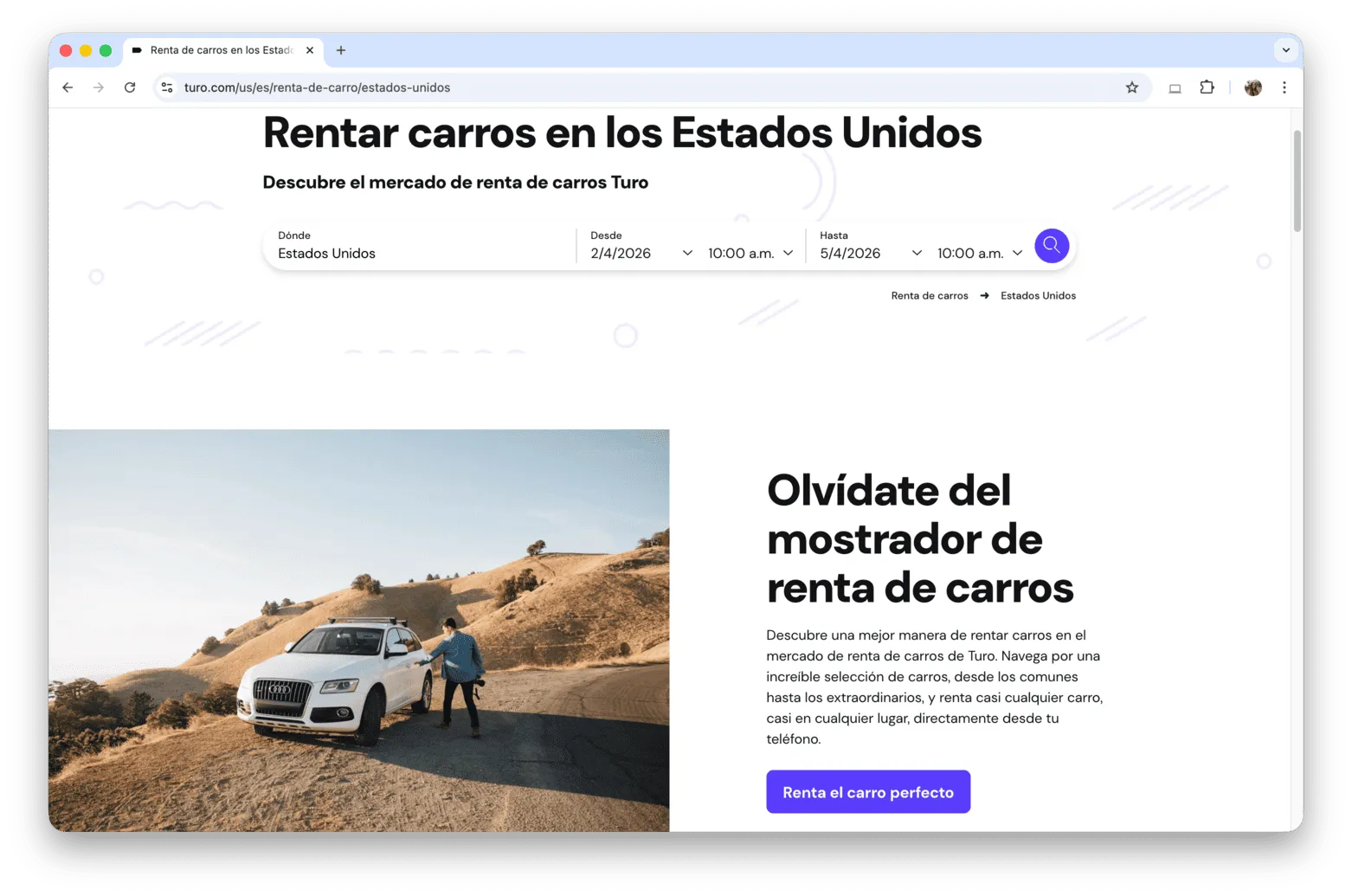
How Turo localized all content to Spanish in one week
With over 42 million people in the U.S. speaking Spanish at home, localization to Spanish was a clear strategic move. Turo didn’t just see this as a demographic trend, they saw it in their own data. Gideon noticed that many guests and hosts in the United States were already using the app with their devices configured to Spanish.
In a marketplace where trust is the primary currency, expanding into a new language can’t be a black-box process. Gideon needed to ensure the AI could handle the nuances of Turo’s specific “personable and concise” voice.
Phase 1: Testing
The team didn’t jump into a full rollout immediately. They began with a targeted exploration within Crowdin to find the best-working solution:
- Translating the glossary: The process started by having AI translate Turo’s internal glossary first to establish a solid foundation.
- The employee feedback loop: Turo leaned on its own team, putting the AI’s glossary translations in front of internal Spanish-speaking employees to see how it measured up.
- Trial and error: Gideon’s team spent several days testing different prompts and iterating on various AI models from OpenAI and Anthropic to find the one that worked best for their brand.
Phase 2: From “clean slate” to full launch
Once the prompts and models were picked up, Turo started from scratch to ensure a high-quality, consistent output.
- From that starting point, it took only one week to translate Turo’s entire ecosystem – iOS, Android, and Web.
- The total token cost for the entire Spanish launch was roughly $100 in AI tokens.
- To verify the results, Turo ran a dedicated QA test with their partner, using Spanish-speaking testers to check for technical issues or missing strings.
The contrast
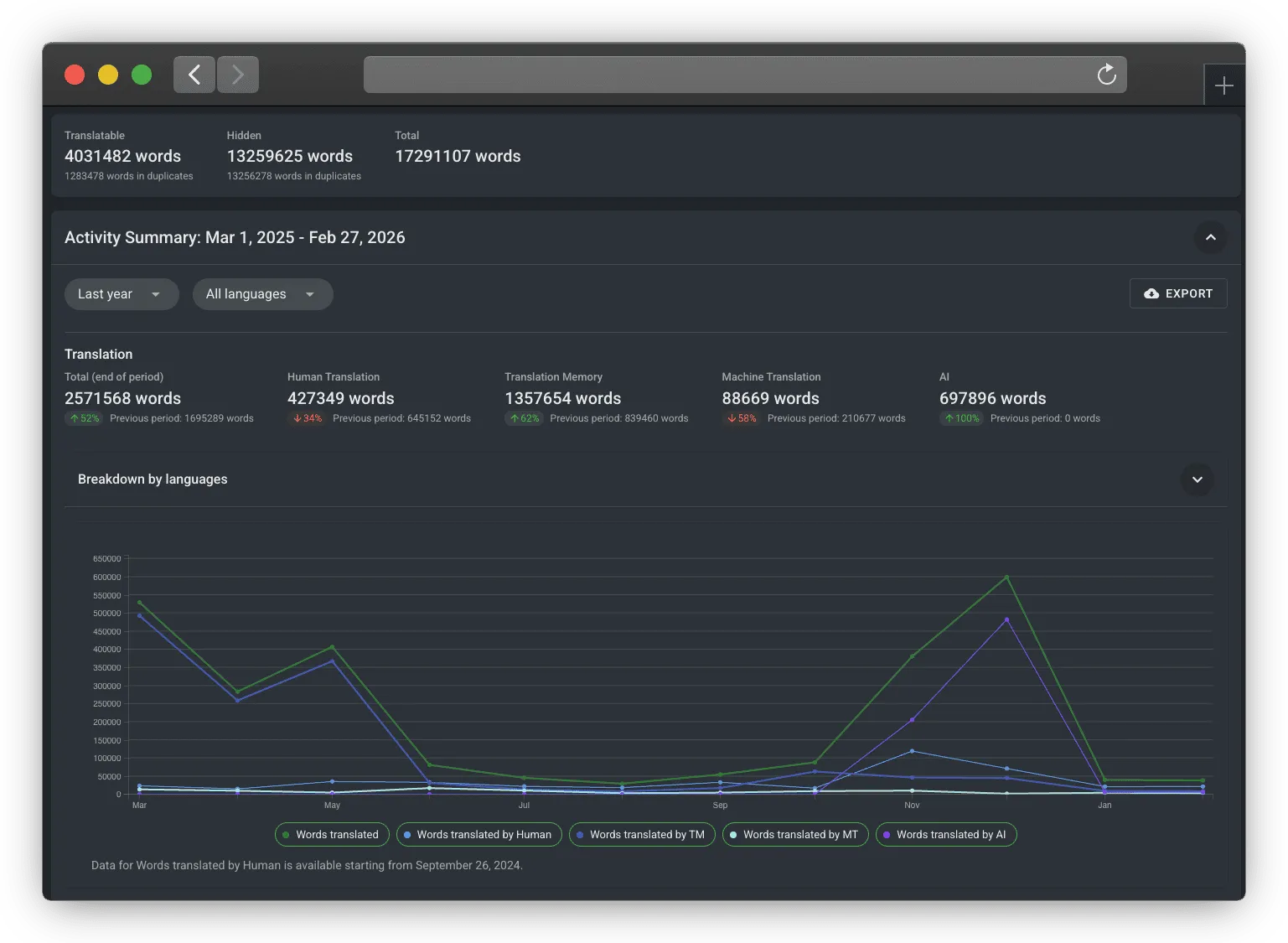
With AI, Turo unlocked a more agile and intelligent way to scale localization.
"What once took months of coordination and manual work can now be accomplished in a fraction of the time and cost, empowering teams to respond quickly to user demand and expand into new markets with greater ease.
By shifting to an AI-first approach, Gideon turned a huge global challenge into a routine project completed much faster.
"The successful implementation of Spanish makes it likely that Turo will add more languages in the coming months.
Localization workflow using AI
To achieve this level of detail at high velocity, Gideon transitioned Turo from a traditional agency model to AI workflows within Crowdin.
Turo’s localization workflow
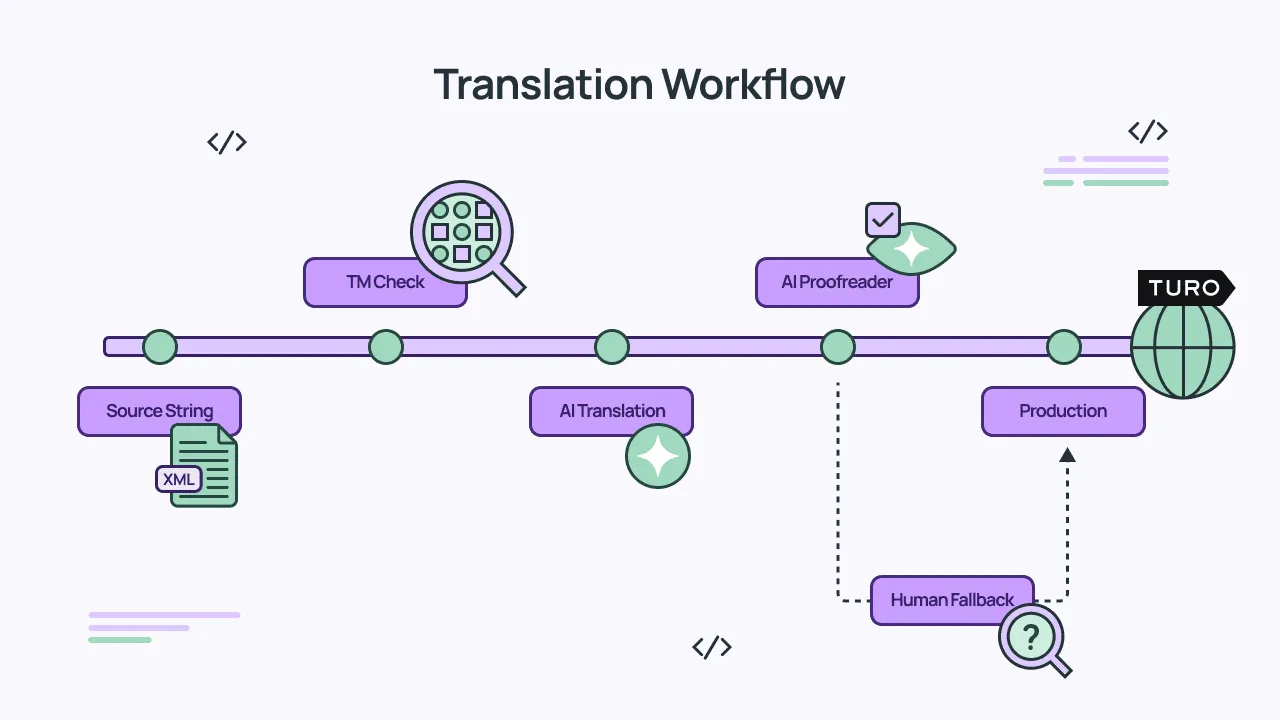
Turo’s workflow functions like an automated translation team, moving strings through a sequence of intelligent tasks:
- Translation Memory (TM) first: Every process starts with the TM. If a string has been translated before, it’s pulled immediately to ensure 100% consistency.
- AI translation: Net-new strings for AI translation, governed by a precise prompt. This prompt tells the AI exactly what tone to use, what vibe to have, and how verbose it should be.
- AI Proofreader: A second AI agent (AI Proofreader) reviews the work. It ensures the translation adheres to the glossary and the Turo persona.
- Fallback to humans: If the AI agents fail or confidence is low, the system automatically routes the string to a human translator.
The fallback rate for human review is now nearly non-existent, with almost all translations being handled automatically.
How Turo keeps their tone of voice consistent
Maintaining a consistent brand voice is critical to building trust. Turo has a very particular set of internal rules for their communication style inside Crowdin: they want to be personable and concise, avoiding anything that sounds too “robotic” or “tone-deaf”.
Previously, meeting these standards in every language required constant checking. Now, Gideon and his team include these tone requirements directly into their AI infrastructure. They tell the AI how to speak, so it sounds authentic in every language.
Localization for App Store
The team goes far beyond the copy to ensure the local vibe is right. This is most visible in their App Store presence, where they adapt every element of the screenshots to match the specific market:
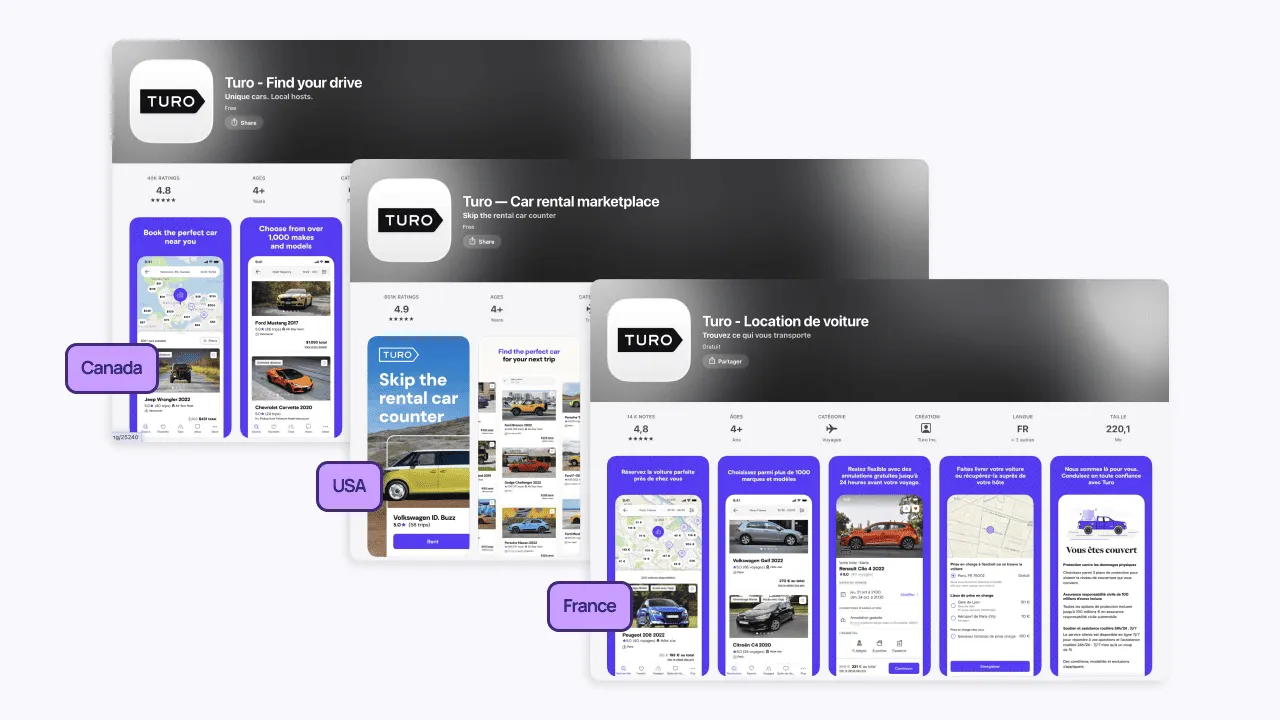
- Turo uses different vehicle photos for different regions. While North American users might see SUVs or Ford Mustangs, users in France will see a Peugeot 208 or a Volkswagen Golf – cars that actually exist in their local catalog.
- Screenshot mockups show searches in cities that make sense for the user, such as Vancouver or Montreal for Canada, and Paris for France.
- The team even conducts local photo shoots to ensure the cars and backgrounds feel authentic to each of the five markets they currently serve.
The Product Ops perspective: Leading the loop
Gideon views Product Operations as the bottom-up engine that powers this speed. Unlike a traditional Product Manager who might focus on a top-down roadmap, Gideon’s role is about execution, velocity, and staying close to the frontline experience.
"Being at the center of everything gives you a perspective that I think is extremely complete.
Gideon’s advice for other leaders trying to scale globally is to leverage the Product Ops role as a central feedback hub. By understanding exactly what market leaders need and what users are experiencing on the ground, Product Ops can find the perfect balance between global consistency and local relevance.
Gideon’s favorite feature in Crowdin
When asked for his favorite Crowdin feature, Gideon pointed to the AI Proofreader’s commentary. He finds it incredibly helpful to see the AI explain its “thought process” – why it chose one word over another or why it recommended a change based on the brand’s persona. Those insights also help us adjust AI prompts and decide where and what context to add.
"It’s been like having a human translator almost, which is kind of crazy

Yuliia Makarenko
Yuliia Makarenko is a marketing specialist with over a decade of experience, and she’s all about creating content that readers will love. She’s a pro at using her skills in SEO, research, and data analysis to write useful content. When she’s not diving into content creation, you can find her reading a good thriller, practicing some yoga, or simply enjoying playtime with her little one.